Should You Tip Before or After Tax?
A clear calculation guide explaining how to calculate tips before and after tax, how differences grow with bill sizes, and how to handle discounts.
The bill arrives, and you reach for your phone calculator. Then you pause. Which number should you type in? Deciding whether to tip before or after tax changes your tip slightly, but the math can feel confusing. This guide walks you through both methods with clear numbers. You’ll also learn how discounts, fees, and unclear receipts affect the calculation.
What Does Tipping Before Tax Actually Mean?
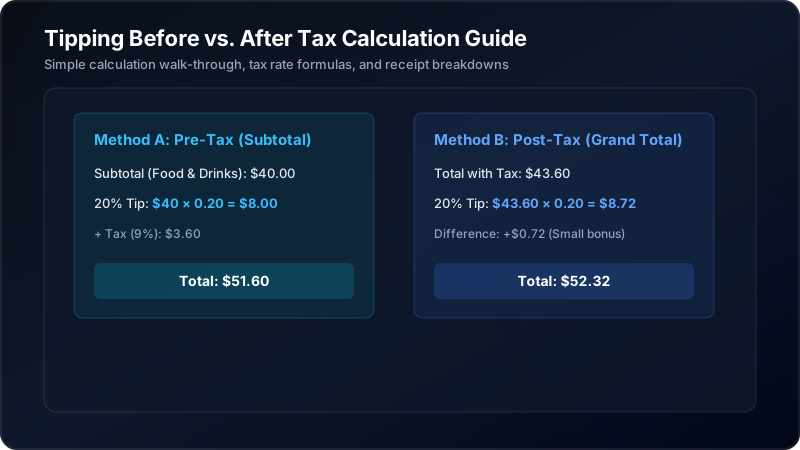
Tipping before tax means basing your tip on the subtotal. That’s the cost of your food and drinks alone. Tax isn’t included in the calculation.
For example, your subtotal is $40, and tax is $3.60. A 20% pre-tax tip is $40 × 0.20 = $8. Your final payment is $40 + $3.60 + $8 = $51.60. This method is widely recommended by etiquette experts in the US.
How Do You Calculate a Tip After Tax?
Start with the total after tax. Using the same example, that’s $43.60. Multiply it by your tip rate. A 20% tip is $43.60 × 0.20 = $8.72.
Then add the tip to the total. You’d pay $43.60 + $8.72 = $52.32. That’s 72 cents more than the pre-tax method. Tipping after tax is also common, and servers certainly don’t mind.
Using the After-Tax Total as a Quick Shortcut
The total is the largest, easiest number to spot on a receipt. Some diners use it for speed. The small extra amount doesn’t bother most people, especially on smaller checks.
How Much Difference Can the Tax Make to Your Tip?
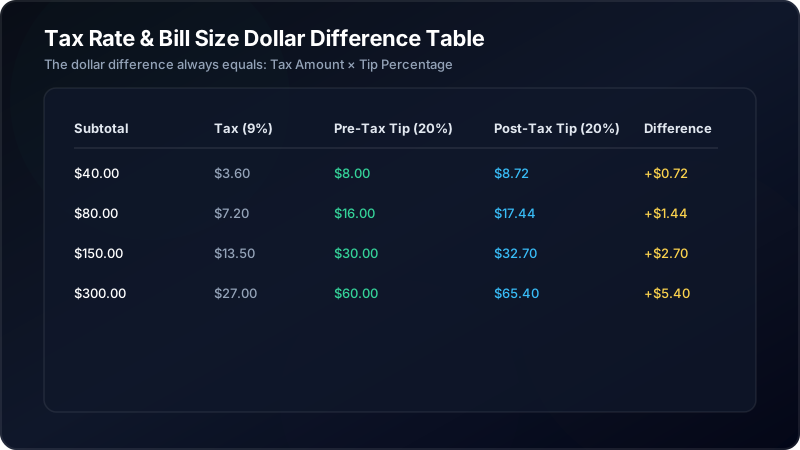
The gap depends on the tax rate and bill size. Higher tax and bigger bills mean a bigger gap. The table below uses a 9% tax rate and a 20% tip.
| Subtotal | Tax (9%) | Pre-Tax Tip | Post-Tax Tip | Difference |
|---|---|---|---|---|
| $40 | $3.60 | $8.00 | $8.72 | $0.72 |
| $80 | $7.20 | $16.00 | $17.44 | $1.44 |
| $150 | $13.50 | $30.00 | $32.70 | $2.70 |
| $300 | $27.00 | $60.00 | $65.40 | $5.40 |
Here’s a handy shortcut. The difference always equals the tax amount times your tip rate. So $27 in tax × 0.20 = $5.40.
What Amount Should You Enter Into a Tip Calculator?
Enter the subtotal for a pre-tax tip. Enter the total for a post-tax tip. The calculator simply multiplies whatever number you give it.
Some calculators have separate fields for subtotal and tax. Use them if available. They’ll show the exact tip on the pre-tax amount and add tax separately. That gives you the clearest picture of your final payment.
How Do Discounts Change the Amount You Use Before Calculating a Tip?
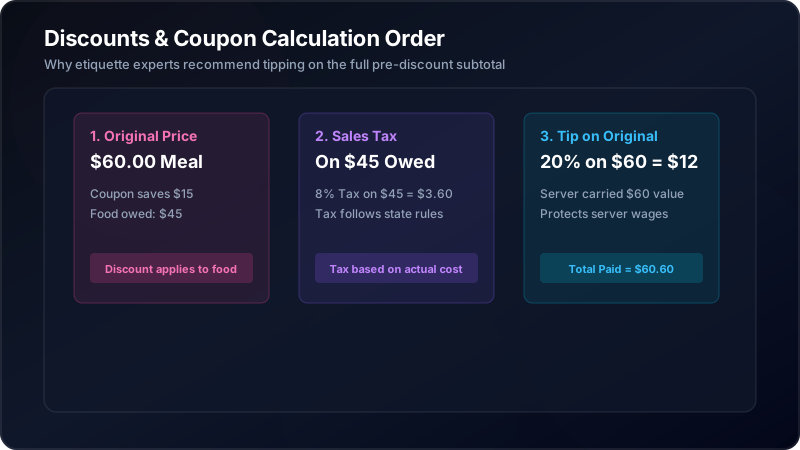
Discounts lower what you pay, but not the work behind your meal. So many diners tip on the original subtotal before the discount. That keeps the tip fair for the server.
For example, your meal is $60, and a coupon takes off $15. Your discounted subtotal is $45. A 20% tip on $60 is $12. A 20% tip on $45 is only $9. Most etiquette advice favors the $12 tip.
Why Servers Appreciate Tips on the Original Price
Your server carried the same plates and refilled the same drinks. The discount came from the restaurant, not from their effort. Tipping on the full price respects that work.
How Can You Compare Pre-Tax and Post-Tax Tip Amounts?
Calculate both, then decide. It only takes a few seconds. Find 20% of the subtotal. Then add 20% of the tax to see the post-tax version.
Case study: Picture a college student with a $30 subtotal and $2.70 in tax. Her pre-tax tip is $6. Adding 20% of the tax, or 54 cents, gives $6.54. She rounds to $7 because her server was attentive. Comparing both made her choice easy.
What Happens When a Receipt Already Includes Suggested Tip Percentages?
Many receipts print suggested tips at the bottom. They might show 18%, 20%, and 22%. These suggestions may use either the subtotal or the total.
Check one suggestion to find out. If 20% equals exactly one-fifth of the subtotal, it’s pre-tax. If it’s slightly higher, it’s post-tax. You can use the suggestion or write your own amount. Suggested gratuity lines are guides, not requirements.
How Do Additional Fees Affect the Tip Calculation?
Some bills include delivery fees, service fees, or credit card surcharges. These fees aren’t food or drinks. Most diners leave them out of the tip base.
A service charge or automatic gratuity is different. It may already cover part or all of the tip. Subtract it from your intended tip, or skip the extra tip entirely. Always read fee labels before you calculate gratuity on the bill.
Leaving Fees Out of the Tip Base
Add up only the food and drink items. Use that number for your tip. This keeps fees from inflating your tip without adding service value.
What Should You Do When the Receipt Does Not Clearly Show the Subtotal?
Some receipts only show a total. In that case, estimate the subtotal. If you know the local tax rate, divide the total by 1 plus the rate. For a $54.50 total at 9% tax, that’s $54.50 ÷ 1.09 = $50.
You can also ask your server for an itemized receipt. Most restaurants provide one quickly. Or simply tip on the total if the difference feels small. All three options are reasonable ways to figure out a tip before tax.
Conclusion
Tipping before tax uses the subtotal, while tipping after tax uses the total. Both are acceptable, and the difference is usually small. Use the original price when discounts apply, and leave fees out of your tip base. Check suggested tips and estimate the subtotal when it’s missing. With these steps, you can calculate a tip before or after tax quickly and fairly.