Global Tipping Customs & Etiquette Guide
A comprehensive international guide on tipping customs across the Americas, Europe, Asia, and Oceania, including how service charges work.
Tipping feels simple at home. Then you land in a new country, and suddenly you’re not sure. Should you leave 20%? Nothing at all? A few coins? Getting it wrong can feel awkward for you and your server. This guide explains how much to tip around the world, region by region. You’ll learn the basic tipping customs, where tips are expected, and where they can even cause confusion. Customs shift over time, so treat these numbers as friendly starting points.
What Are the Basic Tipping Customs Around the World?
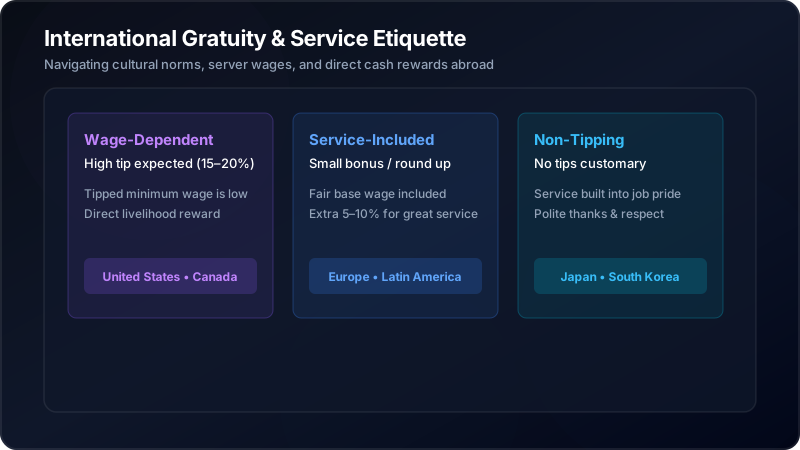
Tipping habits usually follow how workers are paid. In some countries, servers rely on tips for much of their income. In others, fair wages are built into menu prices. That difference shapes almost every tipping culture you’ll meet.
Broadly, the world splits into three groups. Some places expect generous tips. Others welcome a small extra. A few consider tipping unusual. The table below gives a quick overview of common restaurant tipping percentages by country.
| Country | Typical Restaurant Tip | Quick Note |
|---|---|---|
| United States | 15–20% or more | Expected at sit-down restaurants |
| Canada | 15–20% | Similar to the US |
| Mexico | 10–15% | Often given in cash |
| United Kingdom | 10–12.5% | Check for a service charge first |
| France | Small change to 5–10% | Service is included by law |
| Germany | Round up or 5–10% | Tell the server the total you want to pay |
| Japan | None | Tipping can cause confusion |
| Australia | Optional, up to 10% | Not expected |
How Much Should You Tip in the United States and Canada?
North America has one of the strongest tipping traditions. In the US, many servers earn a low base wage and depend on tips. So 15 to 20 percent is standard at sit-down restaurants. Many diners now treat 20% as the norm for good service.
Canada follows a similar pattern. Tips of 15 to 20 percent are common in restaurants. Bartenders often get $1 to $2 per drink in both countries. Taxi drivers, hairdressers, and delivery drivers also expect tips in this range.
Tipping in American Restaurants as a Visitor
Visitors sometimes skip tips because it isn’t done at home. In the US, that can hurt a server’s pay. If service was fine, plan on at least 15%. Card machines usually suggest amounts, so it’s easy to follow local tipping expectations.
What Are the Tipping Expectations in Europe?
Europe is much more relaxed. Many countries include service in the price. In France, menus are “service compris,” meaning service is already covered. Diners often leave small change, or up to 10% for great service.
Other countries vary a little. In the UK, many restaurants add a discretionary service charge of about 12.5%. If it’s there, you don’t need to tip more. In Germany, people usually round up or add 5 to 10%. They tell the server the total when paying, rather than leaving coins on the table. Italy often adds a “coperto,” a cover charge for bread and seating.
How Much Do People Tip in Asia and the Middle East?
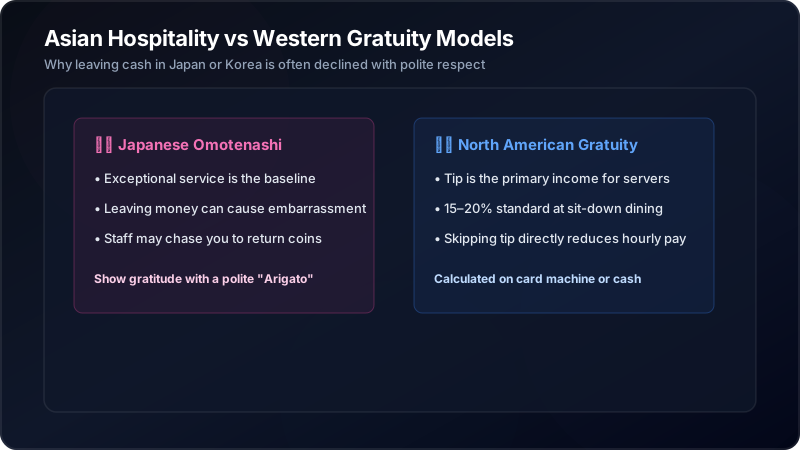
Asia has some of the lowest tipping expectations anywhere. In Japan and South Korea, tipping isn’t customary. Excellent service is simply part of the job. In most local restaurants in China, tips aren’t expected either.
Southeast Asia is more mixed. Thailand welcomes small tips and rounded-up bills. Singapore often adds a 10% service charge, so extra tips aren’t needed. In the Middle East, restaurants in the UAE often include a service charge. Where none appears, 10 to 15% is a kind gesture. In Egypt, small tips are part of daily life for many services.
Understanding Asian Tipping Culture Before You Go
Leaving cash in Japan may lead a server to chase you down to return it. That’s not rudeness. It’s a different custom. Warm thanks and polite manners mean more there than money.
What Should Travelers Know About Tipping in Australia and New Zealand?
In both countries, workers earn solid minimum wages. So tipping isn’t expected. You can simply pay the bill and leave. No one will think you’re rude.
Still, tips are welcome for great service. Around 10% at a nice restaurant is generous. In Australia, some restaurants add a surcharge on Sundays or public holidays. That surcharge isn’t a tip, so read your bill before adding anything extra.
How Can You Avoid Accidental Over-Tipping When Traveling?
Over-tipping usually happens when you apply home habits abroad. Adding 20% in a country where service is included means paying twice. That adds up fast on a two-week trip.
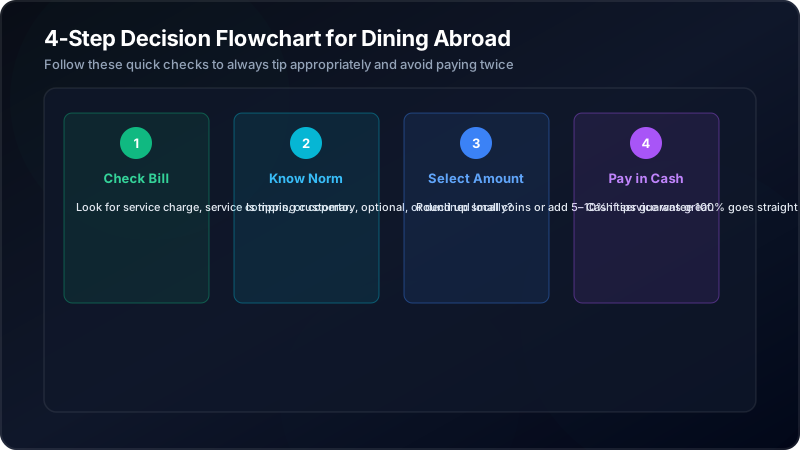
Read every receipt closely. Look for words like “service,” “servizio,” or “service compris.” Ask hotel staff what locals usually leave. Case study: Picture an American couple in Paris who added 20% to every meal. By day five, they noticed “service compris” on their bill. Switching to small change saved them over $100 by the end of the trip.
Which Countries Consider Tipping Unusual or Unnecessary?
Japan and South Korea are the clearest examples. In these places, tipping can feel strange or even confusing. Many local restaurants in China follow a similar pattern. Some Nordic countries, like Denmark, also include service in prices.
In these places, rounding up is usually the most you’ll ever need. Pay attention to tourist areas, though. Hotels and tour companies serving international guests may accept tips. Respect local norms first, and you’ll rarely go wrong.
How Do Local Service Charges Affect Tipping Customs Abroad?
A service charge is a fee added to your bill for service. When it appears, it often replaces the tip. That’s common in the UK, Singapore, the UAE, and many upscale spots in Asia.
However, service charges don’t always reach the staff. Policies differ by country and restaurant. If you want to reward a server directly, leaving a little cash is often the safest option. Just make sure you’re not doubling a full tip by accident.
Reading Foreign Receipts for Service Charges
Receipts may use local words. Look for “service,” “servicio,” “Bedienung,” or “coperto.” A quick translation app helps. This habit protects you from accidental over-tipping on every meal.
What Should You Do When a Country Has Different Tipping Rules by Service?
Many countries treat restaurants, taxis, and hotels differently. In Germany, people round up taxi fares but may tip a bit more at restaurants. In Mexico, tour guides and hotel housekeepers commonly receive tips even when other services don’t.
Ask a local or hotel concierge about each service. Keep small bills in the local currency for quick tips. Guidebooks help too, but local advice is often more current. This way, you’ll handle hotel tipping customs and taxi tipping customs with confidence.
Conclusion
Tipping customs change from border to border. North America expects generous tips, while Europe prefers small extras. Much of East Asia doesn’t tip at all, and Australia keeps it optional. Always check your bill for a service charge, carry local cash, and ask locals when unsure. With these simple habits, you’ll know how to tip when traveling and show respect wherever you go.